



Choosing the right powder coating line is not simply a matter of selecting a larger oven or faster conveyor. It is a production decision involving surface preparation, airflow, curing accuracy, color changes, energy use, labor, and future capacity.
Industry data shows why this decision deserves careful planning. Grand View Research valued the global powder coatings market at approximately USD 15.94 billion in 2022. Its report forecasts a compound annual growth rate of 6.6% from 2023 to 2030. The Powder Coating Institute also emphasizes process control, film thickness, and proper curing as key factors behind consistent quality. As Kevin Coursin, former executive director of the Powder Coating Institute, has stated, “A powder coating line must be designed as a complete system, not a collection of separate machines.” That principle is easy to overlook.
A practical evaluation should examine part dimensions, daily throughput, coating chemistry, oven temperature uniformity, booth recovery, and available floor space. For example, a small workshop may need quick color changes more than maximum conveyor speed. A high-volume plant may prioritize heat recovery and automated loading. Reports from MarketsandMarkets identify automotive, appliances, and architectural applications as important powder coating sectors, each with different performance demands. Still, market forecasts are not a substitute for plant measurements. A line can look excellent on paper and fail beside a drafty loading door. Mistakes happen. The following ten tips connect technical data with real operating conditions, helping buyers question attractive specifications before signing an expensive purchase order.
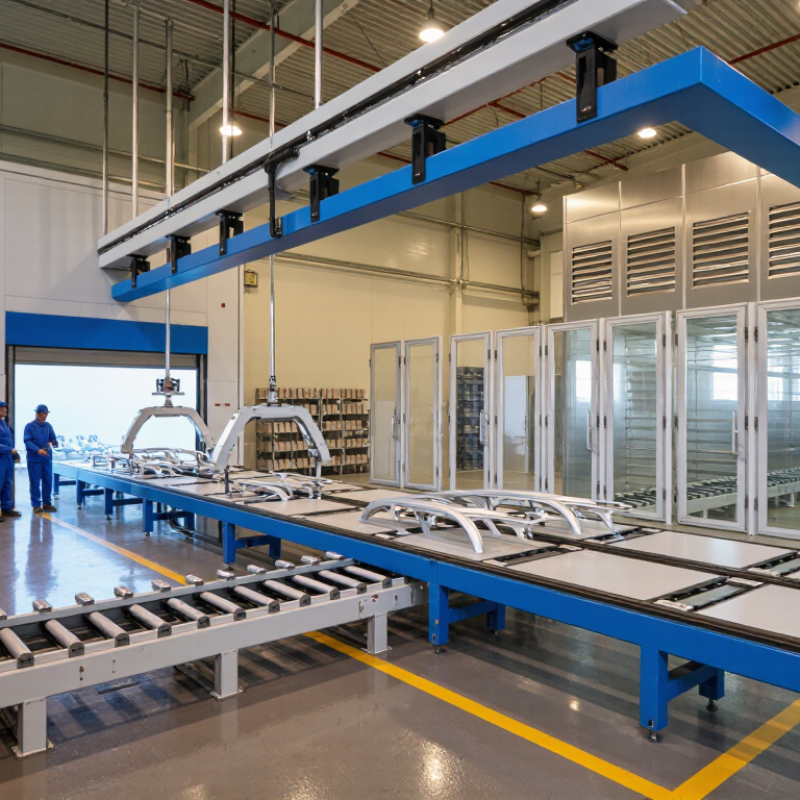
Before choosing a powder coating line, define the product precisely. Record substrate type, maximum dimensions, weight, daily volume, color changes, and required finish. A small steel bracket needs a different process than a two-meter enclosure.
Set measurable coating objectives. Typical powder films range from 60 to 100 micrometres, but corrosion exposure may require a thicker, qualified system. ISO 12944-5:2018 links protective coating selection to environmental severity, not appearance alone. Specify gloss, texture, adhesion, edge coverage, and salt-spray performance. ASTM D7091 supports non-destructive dry-film thickness measurement. The target should be written before equipment discussions begin.
Curing deserves careful attention. Follow the powder manufacturer’s metal-temperature schedule, not merely the oven-air reading. Parts with thick welds may heat slowly. That detail can create under-cured interiors and costly failures. The U.S. Environmental Protection Agency identifies powder coating as a low-VOC finishing method, while the Powder Coating Institute notes that efficient systems can achieve high material utilization through controlled application and recovery. Still, recovery is not automatically suitable for every color or finish. Define reclaim limits, acceptable rework, and cleaning time. Our assumption may be wrong if the product mix changes seasonally. Track actual part temperature, film thickness, defect rate, and energy use during trials before fixing the line specification.
| No. | Requirement to Define | Key Data to Collect | Typical Engineering Reference | Recommended Line Objective | Priority |
|---|---|---|---|---|---|
| 1 | Part dimensions and weight | Maximum length, width, height, weight, shape, and hanging points | Conveyor and booth dimensions should accommodate the largest part with clearance. Load capacity is commonly specified in kilograms per hanger. | Design the conveyor pitch, hanger spacing, booth opening, and oven working zone around the largest and heaviest routine part. | High |
| 2 | Substrate material | Steel, galvanized steel, aluminum, cast metal, or mixed substrates | Different substrates vary in heat transfer, outgassing behavior, corrosion risk, and pretreatment compatibility. | Select pretreatment chemistry, grounding methods, powder type, and oven settings that are compatible with every planned substrate. | High |
| 3 | Required coating thickness | Target film thickness, allowable tolerance, and number of coats | Many general industrial powder coatings are applied at approximately 60–100 micrometers, but the product specification should control the final range. | Use a powder delivery and gun-control system capable of maintaining uniform thickness on flat areas, edges, recesses, and Faraday areas. | High |
| 4 | Appearance and color requirements | Gloss level, texture, color changes, visual standards, and defect limits | Gloss is commonly specified by measurement at a defined angle, while color consistency is normally verified using an approved standard and instrument readings. | Include controlled booth cleaning, color-change procedures, powder recovery rules, and inspection lighting suitable for the required finish. | High |
| 5 | Corrosion-resistance objective | Exposure environment, expected service life, salt-spray requirement, and corrosion class | Outdoor, coastal, chemical, and high-humidity applications generally require more robust pretreatment and coating-system validation than dry indoor applications. | Define the complete system: cleaning, conversion coating, rinse quality, drying, powder chemistry, film thickness, and corrosion testing. | High |
| 6 | Production capacity | Parts per hour, operating shifts, annual volume, product mix, and peak demand | Line speed is determined by conveyor pitch, hanger loading, curing time, and the required hourly output. A higher nominal speed does not guarantee higher usable capacity. | Calculate capacity from actual loading efficiency, changeover time, planned downtime, and reject rate rather than from conveyor speed alone. | High |
| 7 | Curing requirements | Powder technical data sheet, metal temperature, cure time, part thermal mass, and heat-up time | Many thermosetting powders require a specified metal-temperature window, often around 160–200°C, with the exact cure schedule set by the powder formulation. | Size the oven for uniform metal temperature throughout the load; validate the coldest and hottest areas using temperature profiling. | High |
| 8 | Powder utilization and recovery | Transfer efficiency, reclaim percentage, overspray volume, powder waste, and color-change frequency | Recovery can reduce waste for compatible single-color production, but mixed or incompatible powders should not be blended without technical validation. | Choose between reclaim and non-reclaim operation based on product mix, color frequency, contamination risk, quality targets, and material cost. | Medium |
| 9 | Energy and environmental targets | Gas or electrical supply, oven heat loss, ventilation, emissions, and operating hours | Energy use is strongly influenced by oven volume, insulation, exhaust balance, opening size, air leakage, and production loading. | Specify insulated equipment, heat-recovery opportunities, variable-speed airflow where appropriate, and measurable energy consumption per coated part. | Medium |
| 10 | Quality, safety, and future flexibility | Inspection criteria, grounding resistance, operator exposure, automation level, future colors, and product expansion | Effective grounding, interlocked equipment, suitable ventilation, documented inspection, and preventive maintenance are essential for safe and repeatable operation. | Provide measurable acceptance criteria, accessible maintenance points, recipe control, quick-clean components, and spare capacity for future product requirements. | High |