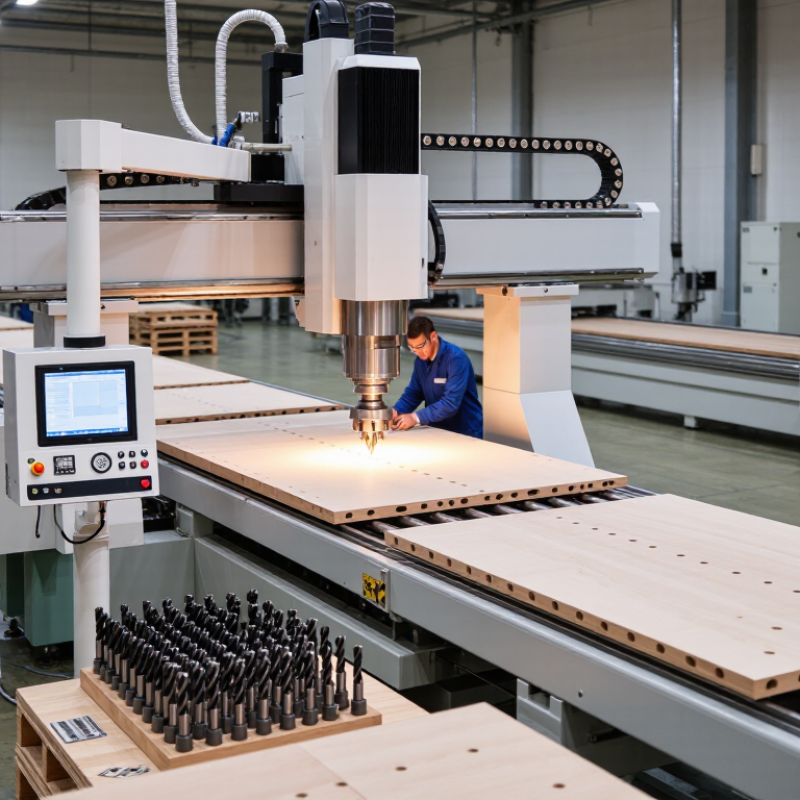
Choosing the China Best CNC Multifunctional Side Hole Drill Supplier requires more than comparing catalog prices. This equipment must deliver accurate side drilling, stable feeding, clean edges, and repeatable performance during demanding production. A reliable supplier should explain spindle power, drilling diameter, workpiece thickness, servo control, dust protection, and after-sales support clearly. Vague promises are warning signs.
David Lin, a CNC manufacturing consultant with more than 20 years of workshop experience, says, “A good machine is not judged by its brochure; it is judged by the hole repeated after thousands of cycles.” His view reflects a practical truth. A CNC Multifunctional Side Hole Drill may appear advanced, yet poor calibration can create uneven holes, tool vibration, or fitting problems during assembly. Small errors become expensive quickly.
This guide examines how Chinese manufacturers design, test, and support the CNC Multifunctional Side Hole Drill. It considers frame rigidity, drilling accuracy, automatic positioning, software usability, component quality, and production testing. Factory videos help, but they are not enough. Ask for sample results, maintenance records, electrical standards, and clear warranty terms. Speak with technical staff, not only sales representatives.
No supplier is perfect. Some factories offer strong engineering but weaker documentation. Others provide attractive prices but limited training. That deserves reflection. The best decision balances machine performance, communication, service response, and long-term operating cost. Buyers should inspect details closely, because reliability is built through evidence, not confident language.
A CNC multifunctional side hole drill is a computer-controlled machine for horizontal drilling on panels, frames, and engineered boards. It follows programmed coordinates, clamps the workpiece, and drives a spindle through the material. Its main value is repeatable side-hole positioning.
Depending on configuration, it can drill, mill grooves, and create dowel or connector holes in one setup. This reduces manual marking and limits handling errors. The operator usually imports a CAD file, selects tool parameters, and checks the first piece. Grand View Research reported a projected 9.5% CAGR for the global CNC machine market from 2023 to 2030. That growth reflects demand for flexible, automated production, not just faster drilling.
Tips: Confirm panel thickness before programming. Use sharp tools and stable clamping. Test one sample first. Measure hole depth manually. It is not a magic box. Dust buildup, poor calibration, or incorrect coordinates can still damage a panel. A useful improvement is adding barcode-based job identification, although this requires disciplined data management. Industry 4.0 reports from McKinsey also link connected machines with better production visibility, but actual gains depend on maintenance habits and operator training.
A CNC multifunctional side hole drill is a computer-controlled machine used to position, drill, and repeat side-hole operations accurately on panels and components. The chart shows common metric hole diameters used for panel-side hardware and connection applications.
Typical applications include 5 mm shelf-pin holes, 8 mm dowel holes, 10 mm connector or dowel holes, 15 mm cam-lock housing holes, and 20 mm connector holes. CNC positioning, programmable drilling depth, automatic tool movement, and repeatable multi-hole processing are the core functions that improve production consistency.
When evaluating a CNC multifunctional side hole drill supplier, inspect more than the catalog. A practical machine should handle repeated side drilling on cabinet panels, shelves, and solid boards. Check the working length, panel thickness range, spindle power, and drilling diameter. Confirm whether the machine supports multiple tool positions and quick bit changes. These details directly affect daily output.
Positioning accuracy and repeatability deserve careful attention. Ask for measured test results, not broad marketing claims. Review axis travel, servo control, drilling depth, and clamping stability. A suitable machine should keep holes aligned after several production cycles. Dust extraction ports, emergency stops, guarded moving parts, and clear control software also matter. A high speed number alone can mislead. I have seen machines perform well on samples but struggle with warped panels. That risk needs honest discussion.
Tips: Request a sample test using your actual board material. Record cycle time, hole accuracy, noise, and dust performance. Ask how operators adjust drilling depth and replace worn tooling. Check spare-part availability, remote support, training, and warranty terms in writing. Suppliers that provide traceable inspection records usually inspire greater confidence. Still, do not treat documents as proof of perfect production. Verify the machine under realistic loads before making a final decision.
China Best CNC Multifunctional Side Hole Drill Supplier
Applications across woodworking and panel processing industries are expanding as manufacturers handle more custom orders. FAO’s 2024 Global Forest Products Facts and Figures report places global wood-based panel production at roughly 390 million cubic metres in 2022. This volume supports demand for faster, repeatable drilling equipment.
A CNC multifunctional side hole drill processes cabinet sides, shelves, partitions, and furniture panels with controlled positioning. It can create dowel holes, connector holes, and concealed fastening points in one workflow. Operators can adjust drilling depth, spacing, and panel dimensions through the control system. That matters when melamine surfaces must remain clean around each opening.
In practical workshops, dust extraction is not a minor detail. Fine particles can affect sensors, clamps, and drill accuracy. A stable pneumatic system also helps prevent panel movement during side drilling. Grand View Research identifies automation and flexible production as important trends in the woodworking machinery market. Yet automation does not remove every risk.
A drill can still fail.
Incorrect tool selection, worn bits, or poor panel calibration may cause chipping. Experienced technicians inspect sample holes before large production runs. They also check spindle alignment after transport or maintenance. No responsible supplier should promise zero errors. Better equipment provides measurable control, easier adjustment, and clearer maintenance procedures for woodworking and panel processing teams.
Selecting a reliable China-based CNC side hole drill supplier requires more than comparing prices. In real production, stable accuracy matters. A supplier should explain spindle speed, drilling depth, worktable size, and compatible materials clearly. Ask for drawings, inspection records, and a live machine demonstration. A careful supplier will discuss limitations, not promise every result. This is important.
Evaluate manufacturing experience through evidence, not polished claims. Request sample holes in your actual panel material and review edge quality, repeatability, dust control, and cycle time. Check how technicians respond when a test fails. Their troubleshooting process often reveals more than a sales presentation. Confirm component sources, software updates, spare-part availability, and operator training. Also examine factory communication. Fast replies help, but accurate replies matter more. I have seen projects delayed by unclear tolerances and incomplete packing lists. Small details become expensive.
Tips: Visit the factory remotely or in person. Compare test results with your drawings. Request customer references from similar applications. Confirm warranty terms, installation support, and response times in writing. Do not choose the lowest quote automatically. A cheaper machine may require more maintenance. Review the final specification twice; even experienced buyers can miss a small but costly detail.
Choosing a China-based CNC multifunctional side hole drill requires more than comparing prices. Manufacturing quality starts with a rigid machine frame, stable servo control, and accurate drilling spindles. Ask for test results covering hole position, depth consistency, and repeated operation. A supplier should explain its inspection process clearly. Photos are useful, but real sample testing is stronger evidence.
In daily production, small errors become expensive. A poorly aligned side hole can affect cabinet assembly and create visible gaps. Experienced suppliers usually check guides, clamps, wiring, and software before shipment. Service support also matters. Confirm installation guidance, spare-part availability, response time, and remote troubleshooting procedures. A clear manual helps, although some manuals remain too technical for new operators. That weakness deserves honest discussion.
Tips: Request a sample using your actual panel material. Measure hole diameter and position after several cycles. Check noise, dust control, tool changes, and emergency-stop performance. Ask who pays for replacement parts during the warranty period. Do not rely on the lowest quotation alone. A lower price may hide limited training or delayed support. Review the contract carefully, and keep realistic expectations about delivery schedules.
| Evaluation Category | Key Data Dimension | Typical Industry Reference or Target | Why It Matters to Buyers | Recommended Verification | Priority |
|---|---|---|---|---|---|
| Machine Configuration | Processing functions | Side drilling, end drilling, slotting, grooving, and optional routing or milling functions according to the machine design | Multifunctional processing can reduce workpiece repositioning, labor input, and cumulative positioning errors. | Review the machine layout, tool list, processing samples, and detailed functional specifications. | High |
| Working Capacity | Workpiece size compatibility | Must be selected according to the buyer’s panel length, width, thickness, hole position, and clamping requirements | A machine may perform well but remain unsuitable if the working envelope does not cover the buyer’s actual panel range. | Compare the supplier’s working range with at least three representative production drawings. | High |
| Drilling Performance | Spindle speed and drilling capacity | Configuration-dependent; high-speed drilling units are commonly used for repeated panel and furniture-hole operations | Spindle speed, tool diameter, material type, and feed rate jointly affect hole quality, cycle time, and tool life. | Request test results using the same board material, tool type, hole diameter, and production conditions. | High |
| Positioning Accuracy | Repeatability and dimensional consistency | Should be stated in the technical specification with a defined measurement method and test condition | Consistent positioning is essential for dowel holes, connector holes, cabinet components, and parts requiring assembly alignment. | Ask for a documented accuracy test, sample measurements, and tolerance records rather than relying only on general claims. | High |
| Mechanical Structure | Frame rigidity and vibration control | Heavy welded or machined structures generally provide better stability than lightweight structures under continuous production loads | Rigidity influences surface quality, hole accuracy, noise level, and long-term mechanical stability. | Inspect frame construction, guideway support, spindle mounting, machine weight, and vibration-control design. | High |
| Drive and Motion System | Guideways, ball screws, racks, and servo or stepper drives | Component selection should match axis load, acceleration, duty cycle, and required positioning performance | Motion-system quality affects accuracy, service life, maintenance frequency, and production reliability. | Confirm component specifications, protection arrangements, lubrication points, and replacement availability. | High |
| Control System | Programming and operation interface | Should support parameter setting, job storage, error alarms, manual operation, and clear operator guidance | An intuitive control system reduces training time and helps operators identify faults quickly. | Request a live software demonstration covering program creation, parameter changes, alarm history, and data backup. | Medium |
| Automation Compatibility | Barcode, CAD/CAM, networking, and production-line integration | Availability depends on the control system and machine configuration; interfaces should be clearly documented | Integration can improve data accuracy, reduce manual input, and support higher-volume manufacturing. | Confirm file formats, communication protocols, barcode requirements, and compatibility with existing production software. | Medium |
| Tool Management | Tool changing and tool-life control | Manual or automatic tool changing may be available; tool capacity should reflect the planned product range | Suitable tool management reduces setup time and helps maintain consistent cutting performance. | Check tool-holder standards, tool-change time, tool-life monitoring, spare-tool requirements, and sharpening recommendations. | Medium |
| Manufacturing Quality | Assembly, wiring, and quality-control process | Important controls include incoming inspection, assembly inspection, electrical testing, calibration, and final trial operation | A documented quality process reduces the risk of hidden assembly defects and inconsistent machine performance. | Request inspection records, electrical test reports, calibration documents, and a factory acceptance test procedure. | High |
| Electrical Safety | Protection and compliance documentation | Should include emergency stops, protective covers, grounding, overload protection, and applicable market compliance documents | Safety features protect operators and may be required for installation, insurance, or import approval. | Verify the electrical schematic, safety-circuit design, conformity documents, and local installation requirements. | High |
| Dust and Chip Management | Extraction ports and dust-control performance | Extraction design should match the number of cutting units, air volume requirements, hose diameter, and workshop layout | Effective dust removal improves visibility, machine cleanliness, tool life, and workplace safety. | Check recommended airflow, extraction-port dimensions, filtration requirements, and test performance with the intended material. | Medium |
| Service Support | Installation, commissioning, and operator training | Support may include remote guidance, manuals, installation instructions, commissioning assistance, and operator training | Good onboarding shortens the time from delivery to stable production and reduces avoidable operating errors. | Obtain a written support scope, training schedule, language options, and responsibilities for installation preparation. | High |
| After-Sales Response | Technical response and spare-parts availability | Response time, remote diagnostic capability, spare-parts stock, and replacement lead time should be contractually defined | Downtime costs can exceed the original price difference between competing machines. | Ask for service channels, escalation procedures, critical spare-parts lists, and typical response commitments. | High |
| Delivery and Acceptance | Lead time, packaging, and factory acceptance testing | Delivery depends on configuration, production schedule, inspection requirements, and shipping method | Clear acceptance criteria help prevent disputes regarding performance, accessories, and delivery condition. | Define packing standards, shipment documents, acceptance samples, performance tolerances, and payment milestones. | High |
| Operating Cost | Power, consumables, maintenance, and labor | Total cost includes electricity, drills and cutters, lubrication, dust extraction, maintenance, and operator time | The lowest purchase price does not always provide the lowest cost per finished part. | Calculate cost per workpiece using expected production volume, tool consumption, labor rates, and planned service intervals. | High |
| Buyer Fit | Production volume and product variety | Choose configuration based on batch size, daily operating hours, material mix, changeover frequency, and future expansion plans | Over-specification increases investment, while under-specification can create bottlenecks and early replacement costs. | Prepare a requirement sheet covering current output, peak demand, product sizes, materials, and expected growth. | High |
| Supplier Assessment | Factory capability and reference validation | Relevant evidence includes production facilities, test equipment, technical staff, export experience, and application references | Verifiable manufacturing capability is more reliable than catalog descriptions or unconfirmed performance statements. | Conduct a factory audit or video inspection and request references using similar materials and production requirements. | High |

Hein Minnie
Cell nr: +27 (0) 82 564 6501
Email: sale@thecirclemachine.com
Hein Minnie Jnr
Cell nr: +27 (0) 84 284 7234
Email: sale@thecirclemachine.com
Address:
10 Apsey Street,
Heidelberg,
Gauteng,
1441
Bendet Engineering Services (PTY) LTD was established in 1987. Our team of engineers and draughtsman are ready to deliver a complete turnkey solution, from the design phase to commissioning. A dedicated team that consists of electrical, mechanical and industrial engineers, we are able to offer a comprehensive service to our clients.